Facts checked Article
Blackjack rule literacy
Blackjack dealer rules for beginners: the rule, the hand, and what it costs
The dealer has no decisions: draw to 16, stand on 17, and the panel says what happens on soft 17. Each dealer rule line, what it costs in percentage points, and what that is on a £20 hand.
blackjack dealer rules for beginners
The dealer in casino blackjack makes no decisions. The dealer draws cards until the hand totals 17 or more and then stops, and the only variable is whether a soft 17 (an ace counted as 11 with a six, A 6) is a stand or a draw.
That is the whole of the dealer’s play rule, and it is printed on the table’s rule panel. The Massachusetts Gaming Commission’s blackjack rules, section 12(b), read 21 September 2026, give the two versions. Draw until a hard or soft total of 17 to 21; or draw until a hard 17 to 21 or a soft 18 to 21.
The second version is “dealer hits soft 17”.
Sources: Massachusetts blackjack rules, s.3, s.6–s.9 and s.12; Wizard of Odds, rule variations.
The dealer’s rule lines
- Draw and stand
- Dealer draws until a hard or soft total of 17 to 21; on the second option, a soft 17 is drawn on (s.12(b))Massachusetts blackjack rules, s.3, s.6–s.9 and s.12 · as checked on
- Blackjack payout
- 3 to 2, or 6 to 5 where the panel says so (s.3(e), s.7)Massachusetts blackjack rules, s.3, s.6–s.9 and s.12 · as checked on
- Insurance
- Offered against a dealer ace; a winning insurance wager pays 2 to 1 (s.9(c))Massachusetts blackjack rules, s.3, s.6–s.9 and s.12 · as checked on
- Cost of the two common lines
- Dealer hits soft 17: 0.22 percentage points; blackjack pays 6 to 5: 1.39 points, against an eight-deck, stand-on-soft-17 baselineWizard of Odds, rule variations · as checked on
- How often the dealer busts
- 28.18% of hands with eight decks and stand on soft 17; 28.57% when the dealer hits soft 17Wizard of Odds, dealer final totals (appendix 2B) · as checked on
- Rules before the bet
- RTS 3A: the applicable rules, including the number of decks, must be easily available before the customer commits to gambleGambling Commission RTS 3 · as checked on
Blackjack pays 6 to 5 — 1.39 points, or £6 on a £20 natural
The other dealer rules are about money rather than cards. A player blackjack (an ace and a ten-value card, A K) is paid at 3 to 2 or, on some tables, 6 to 5. Insurance, offered when the dealer shows an ace, pays 2 to 1.
When the dealer shows an ace or a ten, a player blackjack is paid only after the dealer’s second card is known, and a dealer blackjack makes it a standoff. Each of those lines has a cost, and the table below prices them from the published rule-variation figures.
For a beginner the useful fact is this: nothing the dealer does is a choice, so every line on the panel can be costed in advance. Dealer hits soft 17 costs about 0.22 percentage points. Blackjack paid at 6 to 5 costs 1.39 points.
On a £20 hand, the second of those is the difference between £30 and £24 for a natural.
Sources: Massachusetts blackjack rules, s.3, s.6–s.9 and s.12; Wizard of Odds, rule variations.
Can I find blackjack dealer rules guides on popular casino game apps?
Yes, and on a GB-licensed app the guide is not optional. RTS 3A of the Gambling Commission’s technical standards requires that “an explanation of the applicable rules must be easily available to the customer before they commit to gamble”, and the guidance lists the card deck specification among the content.
RTS 3C requires the house edge, the return to player or the probability of winning in the same place. Read 21 September 2026.
So the rule panel, or the help page behind an “i” button, is where the dealer rules for that app live. The lines to look for are the ones this notebook costs: soft 17, the blackjack payout, the deck count, whether the dealer takes a hole card, and whether surrender is offered.
A guide that gives the draw-to-17 rule and stops, as one UK casino page read on 21 September 2026 does, has told you the line that never varies and left out the four that cost money.
Sources: Gambling Commission RTS 3; Napoleons Casinos, how to play blackjack.
Five panel lines this notebook costs
A guide that gives the draw-to-17 rule and stops has told you the line that never varies and left out the four that cost money.
Ticks are kept only in this browser and are never sent anywhere.
How do blackjack dealer rules vary between different casino software providers?
They vary on a short list of lines, and each line has a published price. The rule-variations table at Wizard of Odds, read 21 September 2026, states each effect against a baseline of eight decks, dealer stands on soft 17, double on any first two cards, double after split, and split to four hands.
Dealer hits soft 17: 0.22 points to the house. Blackjack pays 6 to 5 instead of 3 to 2: 1.39 points. Blackjack pays 1 to 1: 2.27 points.
No hole card, European style, with all bets lost to a dealer blackjack: 0.11 points. Fewer decks help the player: six decks are not listed separately, but four decks give back 0.06 points, two decks 0.19 and one deck 0.48. Late surrender against a ten gives back 0.07 points.
One line dwarfs the rest: a rule that a dealer bust on 22 is a push costs 6.91 points, and it appears in variant games rather than standard tables.
Which lines a given software provider uses is on its panel, not in this notebook. What this notebook adds is the price of each line, so that two panels can be compared in percentage points rather than in adjectives.
Which studio built a table is a question for Studio Ledger; what a live stream does with the cards is a question for Live Table Notes.
Sources: Wizard of Odds, rule variations.
Comparing two rule panels in percentage points
Every line the dealer follows can be costed in advance, because nothing the dealer does is a choice.
Start from the published baseline
Eight decks, dealer stands on soft 17, double on any first two cards, double after split, split to four hands: the Wizard of Odds baseline, read 21 September 2026.
Read each panel line by line
Soft 17, the blackjack payout, the deck count, the hole card and surrender. Each is a line on the panel, not a decision at the table.
Find the row for each line
Table 1 gives the published effect in percentage points: dealer hits soft 17, 0.22; blackjack at 6 to 5, 1.39; no hole card, 0.11; late surrender, 0.07 back.
Write down the costs and add them
The pound column applies each percentage to £2,000 of stakes, £20 a hand for 100 hands. It is arithmetic on the cited figure, not a measurement.
What the result means
Two panels compared in percentage points rather than in adjectives. The total is an expected cost over many hands, not a result on any one of them.
how to play blackjack dealer rules
You do not play the dealer rules; the dealer follows them while you act. The order of a hand under the Massachusetts procedure is this. Each player and the dealer receive two cards, the dealer’s second card face down as a hole card on tables that use one.
Where a card reader is in use and the dealer shows an ace or a ten-value card, the dealer determines whether the hole card makes a blackjack before anyone draws (s.6). Players then stand, draw, double, split or surrender.
Last, the dealer draws until 17 or more under s.12(b), and draws nothing at all if no player hand is still in play (s.12(c)).
The final-total table from Wizard of Odds, eight decks, dealer stands on soft 17, shows what that rule produces over all hands. The dealer finishes on 17 in 14.52% of hands, 18 in 13.93%, 19 in 13.36% and 20 in 17.97%. It makes 21 in 7.28%, a blackjack in 4.75%, and busts in 28.18%.
When the dealer hits soft 17 the bust rate rises to 28.57%, and the dealer’s stronger totals rise with it, which is why the rule costs the player rather than the house.
Sources: Massachusetts blackjack rules, s.3, s.6–s.9 and s.12; Wizard of Odds, dealer final totals (appendix 2B).
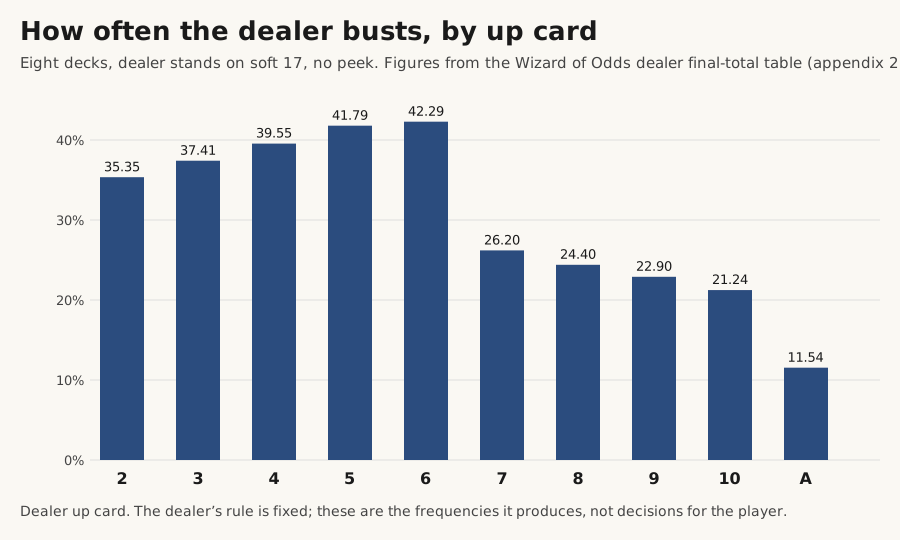
Dealer bust by up card — 42.29% behind a 6, 11.54% behind an ace
By up card the bust rate runs from 42.29% behind a 6 down to 11.54% behind an ace. A hand of 10 6 v dealer 6 faces a dealer who busts more than four hands in ten. The same 10 6 v dealer 10 faces one who busts about two in ten.
Those figures describe the dealer’s rule, not a decision for you; how to play the hand is on a basic-strategy chart, and what any decision costs is a different note.
Sources: Massachusetts blackjack rules, s.3, s.6–s.9 and s.12; Wizard of Odds, dealer final totals (appendix 2B).
what are blackjack dealer rules
Listed as the rule panel writes them. Dealer draws to 16 and stands on all 17s, or dealer hits soft 17: s.12(b), options 1 and 2. Blackjack pays 3 to 2, or 6 to 5: s.3(e) and s.7.
Dealer peeks for blackjack with an ace or ten showing, where a card reader is used: s.6. Insurance pays 2 to 1: s.9(c). Player blackjack against dealer blackjack is a standoff: s.7(b).
Surrender, where offered, forfeits half the wager: s.8. Some tables add optional payouts such as three 7s at 3 to 2 or five cards totalling 21 at 2 to 1: s.3(e). All read 21 September 2026 from the Massachusetts text; a GB table’s own panel governs its game.
Two lines beginners ask about are not dealer rules. The first is “do you automatically win on 21?”. No: a 21 made by drawing beats a dealer 20 but pushes a dealer 21, and only a two-card blackjack outranks every other 21.
The second is “is there a 777 rule?”. Only as an optional payout some licensees offer on three 7s; it is not part of the dealer’s procedure.
Sources: Massachusetts blackjack rules, s.3, s.6–s.9 and s.12; Wizard of Odds, blackjack basics.
The table: rule-variant comparison table
Table 1 sets each dealer-side rule line beside its baseline, its published effect on the house edge in percentage points, and what that effect is worth on a £20 hand over 100 hands. The pound column is the percentage applied to £2,000 of stakes; it is arithmetic on the cited figure, not a measurement.
Use the last column as a checklist: read a panel line, find the row, write down the cost.
| Rule as written on the panel | Baseline it is measured against | Effect on house edge (percentage points) | Cost on £20 a hand over 100 hands | Where the rule is published |
|---|---|---|---|---|
| Dealer hits soft 17 | Dealer stands on soft 17 | +0.22 | £4.40 | Massachusetts s.12(b) option 2; Wizard of Odds |
| Blackjack pays 6 to 5 | Blackjack pays 3 to 2 | +1.39 | £27.80 | Massachusetts s.3(e), s.7; Wizard of Odds |
| Blackjack pays 1 to 1 | Blackjack pays 3 to 2 | +2.27 | £45.40 | Wizard of Odds |
| No hole card; all bets lost to a dealer blackjack | Dealer peeks; only the original bet is lost | +0.11 | £2.20 | Wizard of Odds |
| Dealer bust on 22 is a push | Dealer bust loses | +6.91 | £138.20 | Wizard of Odds |
| Late surrender offered | No surrender | −0.07 | −£1.40 | Massachusetts s.8; Wizard of Odds |
| Four decks | Eight decks | −0.06 | −£1.20 | Wizard of Odds |
| Two decks | Eight decks | −0.19 | −£3.80 | Wizard of Odds |
| One deck | Eight decks | −0.48 | −£9.60 | Wizard of Odds |
| Insurance taken for half the stake against an ace | No insurance | Costs 7.47% of the insurance stake (eight decks) | 75p per £10 insured | Massachusetts s.9(c); Wizard of Odds appendix 2B |
Sources: Wizard of Odds, rule variations; Massachusetts blackjack rules, s.3, s.6–s.9 and s.12; Wizard of Odds, dealer final totals (appendix 2B).
Dealer rule lines, costed
| Rule as written on the panel | Baseline | Effect on house edge (percentage points) | On £20 × 100 hands (£) | Evidence |
|---|---|---|---|---|
| Dealer hits soft 17 | Dealer stands on soft 17 | 0.22 | 4.4 | · Wizard of Odds, rule variations |
| Blackjack pays 6 to 5 | Blackjack pays 3 to 2 | 1.39 | 27.8 | · Wizard of Odds, rule variations |
| Blackjack pays 1 to 1 | Blackjack pays 3 to 2 | 2.27 | 45.4 | · Wizard of Odds, rule variations |
| No hole card, all bets lost to a dealer blackjack | Dealer peeks | 0.11 | 2.2 | · Wizard of Odds, rule variations |
| Dealer bust on 22 is a push | Dealer bust loses | 6.91 | 138.2 | · Wizard of Odds, rule variations |
| Late surrender offered | No surrender | -0.07 | -1.4 | · Wizard of Odds, rule variations |
| Four decks | Eight decks | -0.06 | -1.2 | · Wizard of Odds, rule variations |
| Two decks | Eight decks | -0.19 | -3.8 | · Wizard of Odds, rule variations |
| One deck | Eight decks | -0.48 | -9.6 | · Wizard of Odds, rule variations |
The £ column is the percentage applied to £2,000 of stakes (£20 a hand for 100 hands); arithmetic on the cited figure, not a measurement.
What a panel line costs on your stake
Enter a stake, a number of hands and the house edge for the panel you are reading. The published figure is 0.43% for eight decks, dealer stands on soft 17, double any two, double after split, split to four; add 0.22 for hits soft 17 and 1.39 for 6 to 5. Outputs are expected costs, not results.
Worked example: with stake per hand £20.00, number of hands 100, house edge for this panel 0.43%, expected cost over the hands entered is £8.60 and extra cost if the panel says dealer hits soft 17 (0.22 points) is £4.40 and extra cost if blackjack pays 6 to 5 (1.39 points) is £27.80 and difference on one natural: 3 to 2 against 6 to 5 is £6.00. £20 for 100 hands at 0.43%: £8.60 expected cost; £4.40 more if the dealer hits soft 17; £27.80 more if blackjack pays 6 to 5; £6.00 less on each natural at 6 to 5.
Formula and figures: Wizard of Odds, rule variations
A worked example in pounds
A £20 hand. You hold A K, a blackjack. The dealer shows a 7.
Under s.7(a) the dealer pays the blackjack at once: £30 at 3 to 2, so £50 comes back; or £24 at 6 to 5, so £44 comes back. The panel line “Blackjack pays 6 to 5” has cost £6 on this one hand.
Over the roughly 4.75 naturals dealt to a player in 100 hands it costs about £28.50, which is where the 1.39-point figure comes from.
Sources: Massachusetts blackjack rules, s.3, s.6–s.9 and s.12; Wizard of Odds, dealer final totals (appendix 2B); Wizard of Odds, rule variations.
Insurance and soft 17 — 75p per £10 insured, 4.4p on a £20 hand
Same stake, and the dealer shows an ace. The dealer offers insurance: up to half your stake, £10, paying 2 to 1 if the hole card is a ten-value card (s.9). With eight decks the dealer has a blackjack behind an ace in 30.84% of hands, from the appendix 2B table.
So £10 of insurance returns £20 in 30.84% of cases and loses £10 in 69.16%. That is an expected return of £6.17 for £10 staked, a cost of £3.83 on the hands where it is taken, which is 7.47% of the insurance stake, or 75p per £10 insured over time.
That is the price of the line, whatever the main hand does.
Same stake, and the panel says “Dealer hits soft 17”. Nothing on this hand shows it; the cost is 0.22 points of every hand, 4.4p on £20, £4.40 across 100 hands. Doubling to get back a lost hand changes the variance, not the edge.
If that is the reason for the next bet, GamCare’s helpline is 0808 8020 133, free, 24 hours.
Sources: Massachusetts blackjack rules, s.3, s.6–s.9 and s.12; Wizard of Odds, dealer final totals (appendix 2B); Wizard of Odds, rule variations.
The worked example, line by line, on a £20 hand
| Rule as written on the panel | The hand | What it costs | Evidence |
|---|---|---|---|
| Blackjack pays 6 to 5 (instead of 3 to 2) | A K against a dealer 7: paid £24 instead of £30 and £44 comes back instead of £50 | £6 on this one hand; about £28.50 over the roughly 4.75 naturals dealt in 100 hands | · Massachusetts blackjack rules, s.3, s.6–s.9 and s.12 |
| Insurance pays 2 to 1 | Dealer shows an ace; £10 insured and paid 2 to 1 if the hole card is a ten-value card, which happens in 30.84% of hands with eight decks | Expected return £6.17 for £10 staked: a cost of £3.83 when taken, 7.47% of the insurance stake, or 75p per £10 insured over time | · Wizard of Odds, dealer final totals (appendix 2B) |
| Dealer hits soft 17 | Nothing on this hand shows it | 0.22 points of every hand: 4.4p on £20, £4.40 across 100 hands | · Wizard of Odds, rule variations |
What this page does not tell you
It does not tell you how to play any hand. The dealer’s rule is fixed; the player’s decisions are a separate subject, and what each one costs under a stated rule set belongs in a note on basic strategy, not here.
It does not name any UK operator’s panel; none was fetched for this note, so no table is described as using any rule. It does not cover side bets, progressive wagers or the variant games with the 22-push rule beyond pricing that one line.
The Massachusetts rulebook is a United States regulator’s text, cited as a complete published statement of the standard procedure; it does not bind a GB operator, whose own panel governs under RTS 3.
The final-total percentages are for eight decks and a dealer who stands on soft 17 under no-peek rules; other deck counts and the hit-soft-17 table differ slightly and are on the cited page. Why a fixed edge behaves as it does over many hands is Odds & Ends’ subject, and this notebook cites it rather than repeating it.
Sources: Gambling Commission RTS 3.
Terms used in this note
- Natural
- A two-card blackjack: an ace and a ten-value card, A K. It outranks every other 21.
- Push
- A standoff. Neither the player nor the dealer wins the hand and the stake is returned.
- House edge
- The share of each stake a rule set costs the player in expectation over many hands, stated in percentage points.
- Return to player
- The share of stakes a rule set returns to the player in expectation; the house edge is the remainder.
- Variance
- How widely results spread around the expected cost over a run of hands. A bet can change the variance without changing the edge.
- RTS
- The Gambling Commission’s remote gambling and software technical standards, which say what a GB-licensed game must publish before a bet.
- Progressive wager
- A side wager whose prize grows as stakes are added to it. This note does not cover side bets.
Questions answered
The six questions below are the stored phrasings readers use for the dealer’s rules; each answer gives the rule first and the source second.
Questions answered
What are the dealer rules in blackjack?
The dealer draws until the hand totals 17 or more and then stands; the panel says whether a soft 17 is drawn on. Blackjack is paid at 3 to 2 or 6 to 5, insurance pays 2 to 1, and a dealer blackjack makes a player blackjack a standoff. Surrender, where offered, returns half the stake. Massachusetts rules s.3, s.7, s.8, s.9 and s.12, read 21 September 2026.
Source: Massachusetts blackjack rules, s.3, s.6–s.9 and s.12
What are the specific dealer hit or stand rules in live dealer blackjack games?
The same two options as any table: draw to a hard or soft 17 to 21 and stand, or draw on soft 17 and stand on hard 17 and soft 18 or better. Which one a live table uses is on its panel; the second option costs about 0.22 percentage points more.
Source: Wizard of Odds, rule variations
What are the standard blackjack dealer rules used in UK online casinos?
There is no single standard, and this note did not fetch any UK operator’s panel, so it names none. A GB-licensed game must make its rules, including the deck count, easily available before you bet (RTS 3A), so the panel is the document to read, and Table 1 prices each line.
Source: Gambling Commission RTS 3
Which online platforms offer blackjack games with classic dealer rules?
This note does not recommend platforms or say which use which rule. The word classic usually means dealer stands on soft 17 and blackjack pays 3 to 2. Check both lines on the panel, because a table that changes either one costs 0.22 or 1.39 percentage points more.
Source: Wizard of Odds, rule variations
What is the 777 rule in blackjack?
Not a dealer rule but an optional payout: the Massachusetts rules let a licensee pay three 7s of any suit at 3 to 2, with notice at the table. Where a panel does not list it, it does not apply.
Source: Massachusetts blackjack rules, s.3, s.6–s.9 and s.12
What is the golden rule of blackjack?
No rulebook read for this note contains a rule by that name, so we do not state one. The fixed rule that comes closest is the dealer’s: draw to 16, stand on 17, with soft 17 as the panel says.
Source: Massachusetts blackjack rules, s.3, s.6–s.9 and s.12
Sources checked 21 September 2026
Every rule and every percentage above was read from the documents below on 21 September 2026. The pound figures are those percentages applied to £20 and to 100 hands; no table was played and no operator panel was fetched.
Rule references
Read on 21 September 2026; re-check with the next refresh of this article.
| Source | Publisher | Read on | Re-check due | Note |
|---|---|---|---|---|
| Massachusetts blackjack rules, s.3, s.6–s.9 and s.12 | Massachusetts Gaming Commission | On the next revisit | Text extracted with pdftotext on 21 September 2026. s.3(e): winning wagers pay 1 to 1 except a blackjack at 3 to 2 or 6 to 5; optional payouts a licensee may offer include three 7s at 3 to 2 and five cards totalling 21 at 2 to 1. s.6: with a card reader and an ace or ten-value card showing, the dealer determines whether the hole card gives a blackjack before dealing further. s.7: a player blackjack against a dealer ace or ten is paid only after the dealer’s second card; a dealer blackjack makes it a standoff. s.8: surrender forfeits one-half of the wager. s.9(c): winning insurance pays 2 to 1. s.12(b): the dealer draws until a hard or soft total of 17 to 21 (option 1), or until a hard 17 to 21 or a soft 18 to 21 (option 2, dealer hits soft 17). s.12(c): the dealer draws no card when it cannot affect the result. | |
| Wizard of Odds, rule variations | Wizard of Odds | On the next revisit | Baseline: eight decks, dealer stands on soft 17, double on any first two cards, double after split, split to four hands. Dealer hits soft 17: −0.22%. Blackjack pays 6 to 5: −1.39%. Blackjack pays 1 to 1: −2.27%. European no hole card: −0.11%. Player may not double: −1.48%. Double on 10–11 only: −0.18%. Late surrender against ten: +0.07%. Single deck: +0.48%; double deck: +0.19%; four decks: +0.06%. Dealer bust on 22 is a push: −6.91%. | |
| Wizard of Odds, blackjack basics | Wizard of Odds | On the next revisit | “If the dealer has 16 or less, then he will draw another card”; soft 17 is hit at some tables; a blackjack outranks other 21s; player and dealer blackjack push; insurance pays 2 to 1; house edge 0.43% under dealer stands on soft 17, split to four hands, double after split, double any two cards, with basic strategy. | |
| Wizard of Odds, dealer final totals (appendix 2B) | Wizard of Odds | On the next revisit | Eight decks, dealer stands on soft 17, no peek: overall dealer final totals 17: 0.145215, 18: 0.139318, 19: 0.133629, 20: 0.179709, 21: 0.072838, blackjack: 0.0474513, bust: 0.281839. Bust by up card: 2 0.35353, 3 0.374115, 4 0.395469, 5 0.417902, 6 0.422922, 7 0.262031, 8 0.243954, 9 0.229037, 10 0.212381, ace 0.115426. Ace up: blackjack 0.308434. Dealer hits soft 17: overall bust 0.285675. | |
| Gambling Commission RTS 3 | Gambling Commission | On the next revisit | Page last updated 7 May 2024. RTS 3A: “An explanation of the applicable rules must be easily available to the customer before they commit to gamble”; guidance lists card deck specifications. RTS 3C: house edge, RTP or probability of winning easily available before the gamble. | |
| Napoleons Casinos, how to play blackjack | Napoleons Casinos | On the next revisit | Competitor page read 21 September 2026 for what it omits: it states the dealer draws to 17 or higher and stands on soft 17; it does not state the blackjack payout ratio, insurance, the deck count or the hole-card rule. Not cited for any rule figure. |
Questions answered
What are the dealer rules in blackjack?
Draw to 16, stand on 17, soft 17 as the panel says; blackjack pays 3 to 2 or 6 to 5; insurance pays 2 to 1; a dealer blackjack makes a player blackjack a standoff.
What are the specific dealer hit or stand rules in live dealer blackjack games?
The same two options as any table, stand or hit on soft 17; the panel says which, and hitting costs about 0.22 percentage points.
What are the standard blackjack dealer rules used in UK online casinos?
No single standard; RTS 3A requires each game to publish its rules before the bet, and Table 1 prices each line.
Which online platforms offer blackjack games with classic dealer rules?
This note names none; check the soft-17 and payout lines on any panel, which cost 0.22 and 1.39 points when changed.
What is the 777 rule in blackjack?
An optional payout some licensees offer on three 7s at 3 to 2, not a dealer rule.
What is the golden rule of blackjack?
No rulebook read for this note contains one; the nearest fixed rule is the dealer’s draw-to-16, stand-on-17 procedure.
Rule references
- Blackjack rules (Massachusetts Gaming Commission, file dated 9 April 2026)
- Blackjack rule variations: effect of each rule on the house edge
- Blackjack: rules and house edge under Atlantic City rules
- Dealer odds in blackjack under European rules: final-total probabilities by up card
- Remote gambling and software technical standards: RTS 3 – Rules, game descriptions and the likelihood of winning
- How to play blackjack (Napoleons Casinos)
Continue reading
Read the payout before the table name
A blackjack label alone does not tell you how a winning natural is paid.
Read Read the payout before the table name
Soft seventeen is a rule question
A soft blackjack total includes an ace counted as eleven.
Read Soft seventeen is a rule question
Blackjack surrender depends on when the dealer's blackjack is resolved
Read early, late and conditional surrender through a £20 settlement table. See why requesting surrender before the reveal need not guarantee half back.
Read Blackjack surrender depends on when the dealer's blackjack is resolved
Splitting aces changes the permitted hand, not just the total
Follow two split-ace hands through a £20 settlement ledger. Separate one-card restrictions, re-splitting, blackjack classification and dealer-blackjack treatment.
Read Splitting aces changes the permitted hand, not just the total
Which blackjack table rules change the house edge, and by how much
Soft 17, 6:5 payouts, double after split, re-split aces, surrender, deck count and dealer peek: what each rule adds to the house edge, with the arithmetic and a rule-panel checklist.
Read Which blackjack table rules change the house edge, and by how much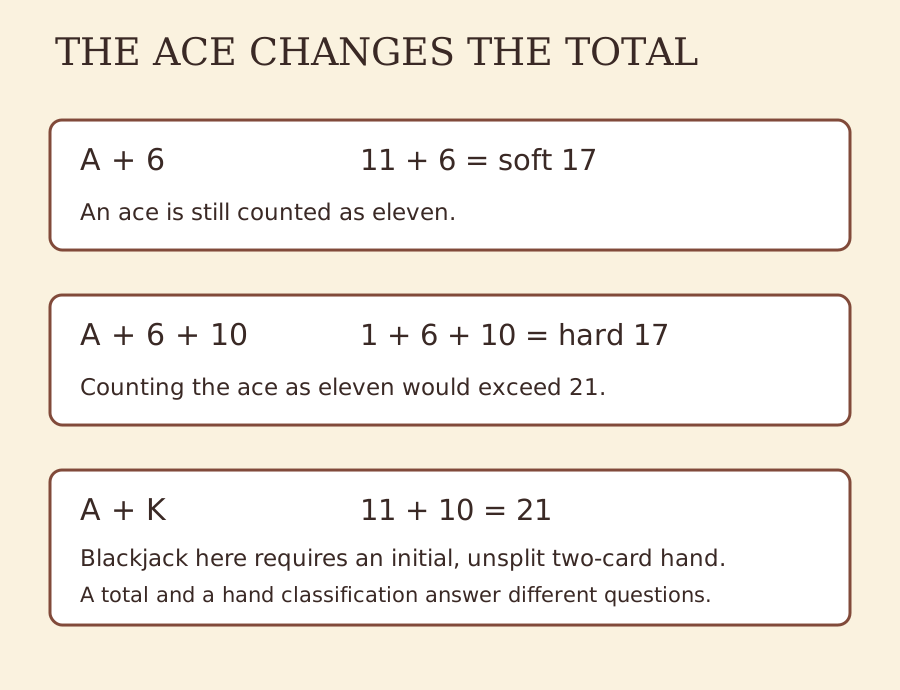
Online blackjack explained: hands, aces and the rules that change them
Work through soft and hard hands, two-card blackjack, payout wording and dealer rules without mistaking a familiar game name for a complete rule set.
Read Online blackjack explained: hands, aces and the rules that change them
Continue reading
Blackjack surrender depends on when the dealer's blackjack is resolved
Read early, late and conditional surrender through a £20 settlement table. See why requesting surrender before the reveal need not guarantee half back.
Read Blackjack surrender depends on when the dealer's blackjack is resolvedSplitting aces changes the permitted hand, not just the total
Follow two split-ace hands through a £20 settlement ledger. Separate one-card restrictions, re-splitting, blackjack classification and dealer-blackjack treatment.
Read Splitting aces changes the permitted hand, not just the totalRead the payout before the table name
A blackjack label alone does not tell you how a winning natural is paid.
Read Read the payout before the table nameRecord the rules you need to check
Read the payout before the table name
Soft seventeen is a rule question
Which blackjack table rules change the house edge, and by how much
Blackjack surrender depends on when the dealer's blackjack is resolved
Online blackjack explained: hands, aces and the rules that change them
Splitting aces changes the permitted hand, not just the total