Facts checked Article
Blackjack rule literacy
Splitting aces changes the permitted hand, not just the total
Follow two split-ace hands through a £20 settlement ledger. Separate one-card restrictions, re-splitting, blackjack classification and dealer-blackjack treatment.
Two cards totalling 21 need their own rule label
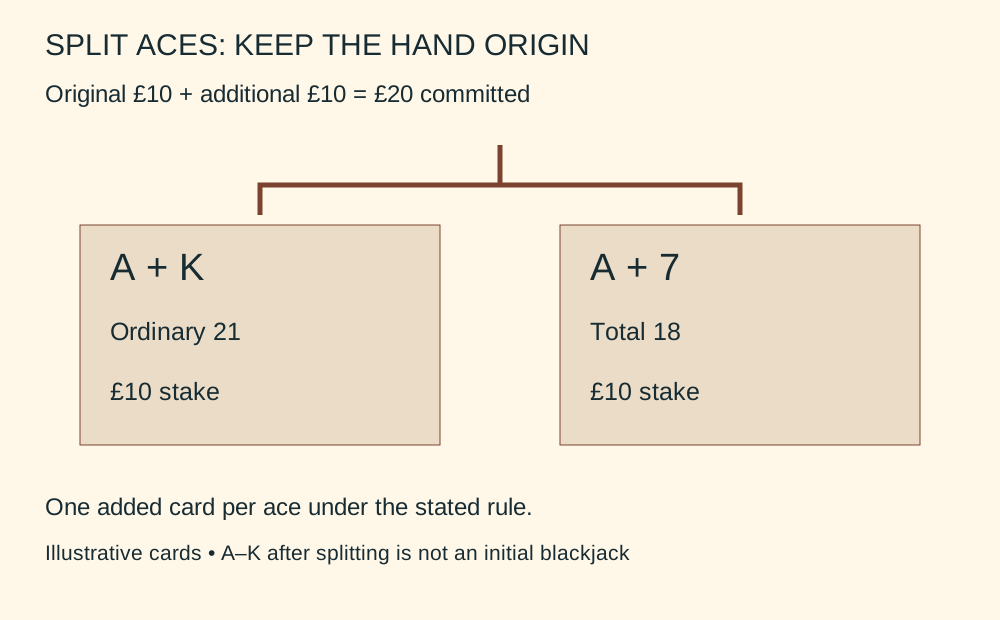
An ace followed by a ten-value card after a split can total 21 without being blackjack. Under the Massachusetts Gaming Commission's published definition, cards received after splitting are excluded from blackjack. The point total and the hand's origin are separate pieces of information.
That distinction matters when an online rule panel advertises a premium blackjack payout.
The other restriction to find is what happens after the first extra card. PokerStars' public Live Blackjack rules describe one split into two hands and one additional card to each split ace. The Massachusetts rules also specify one card per split ace, while allowing some separately notified variations in the number of splits.
These are documented examples, not evidence that every online table follows the same package.
This note traces a pair of aces through a small paper ledger. It explains which questions a rule panel must answer before its split option is understood. It does not recommend a move against a particular dealer card or provide a strategy chart for an unspecified game.
Sources: Blackjack rules, 9 April 2026; Live Blackjack Rules - How to play Blackjack live.
Split aces on the rule panel — what the two documents say
- Ace plus ten-value card after a split
- It can total 21 without being blackjack. Under the Massachusetts Gaming Commission's published definition, cards received after splitting are excluded from blackjack.Blackjack rules, 9 April 2026 · as checked on
- PokerStars' described split
- Its public Live Blackjack rules describe one split into two hands and one additional card to each split ace.Live Blackjack Rules - How to play Blackjack live · as checked on
- Massachusetts on the extra card
- One card per split ace, while allowing some separately notified variations in the number of splits.Blackjack rules, 9 April 2026 · as checked on
- Status of the two documents
- Documented examples, not evidence that every online table follows the same package. The point total and the hand's origin are separate pieces of information.Live Blackjack Rules - How to play Blackjack live · as checked on
Two public rule documents compared; no dealing sequence or account activity was observed for this note.
The additional stake belongs in the first line
Start with a hypothetical £10 opening wager and two aces. Splitting creates two hands with £10 attached to each. The second £10 is an additional commitment, bringing the total to £20.
It is not a free second attempt supplied by the original wager. Both cited rule examples require an equal additional stake for the second hand.
For the worksheet below, assume the next card on the first ace is a king and the next card on the second ace is a seven. Those cards produce totals of 21 and 18. They are invented cards chosen to show two different settlements; no dealing sequence or account activity was observed.
Under the one-card rule, both split-ace hands have received their permitted extra card. The presence of an ace that can be counted as eleven does not create permission to draw again. An ordinary soft hand and a hand created by splitting aces can have different available actions even when their visible totals look familiar.
Read the origin of the hand alongside the cards.
Sources: Blackjack rules, 9 April 2026; Live Blackjack Rules - How to play Blackjack live.
The £20 ledger against three dealer totals
Assume ordinary wins pay 1:1, equal non-blackjack totals push, and the ace-king created by splitting is ordinary 21. None of the dealer results in this table is a two-card blackjack. The table changes only the dealer's final total; the two player hands and the £20 combined stake remain fixed.
Against 19, a winning 21 does not mean the pair of split hands made money: its £10 profit offsets the other hand's £10 loss. Against a three-card 21, the first hand returns its £10 stake and the second loses. A push is a returned stake, not a paid win.
The table deliberately avoids probabilities. Three examples are not three equally likely outcomes, and averaging their net results would not calculate the game's house edge. Their purpose is to expose accounting errors when several hands come from one opening decision.
| Dealer finishes with | Split A–K return | Split A–7 return | Total returned | Net from £20 |
|---|---|---|---|---|
| 17 | £20 | £20 | £40 | +£20 |
| 19 | £20 | £0 | £20 | £0 |
| Three-card 21 | £10 | £0 | £10 | −£10 |
Sources: Blackjack Rules - Learn How to Play Blackjack; Blackjack rules, 9 April 2026.
A premium payout cannot be inferred from the sum
On a hypothetical table paying 3:2 for a qualifying initial blackjack, a winning £10 natural produces £15 profit and a £25 total return. A winning ordinary 21 at 1:1 produces £10 profit and a £20 return. The £5 difference follows from the hand classification and the stated payout, not from changing the arithmetic of ace plus king.
The Massachusetts definition makes the classification explicit. It is a useful rule reference, but it is not authority for the terms of an unidentified UK game. For an online table, find the corresponding definition in that game's help.
A large 3:2 label does not answer whether a particular two-card hand qualifies after splitting.
Write the condition in a complete sentence: initial blackjack receives the stated premium, while 21 made after splitting receives ordinary settlement under this example. That is more useful than a notebook entry saying blackjack pays 3:2. The shorter entry loses the condition that caused the disputed amount in the first place.
Keep any 6:5 or other alternative out of the calculation unless the exact table actually states it.
Sources: Blackjack rules, 9 April 2026; Blackjack Rules - Learn How to Play Blackjack.
Words on the panel
- Natural
- An initial two-card blackjack. Under the cited definition, an ace and a ten-value card made after splitting is not one.
- Ordinary 21
- A hand totalling 21 that does not qualify as blackjack, such as a split ace plus a king; it settles at the ordinary rate.
- Push
- A tied result against the dealer: the stake comes back and nothing is paid.
- Settlement
- How a hand is paid, pushed or lost once the dealer's total is known; each split hand settles on its own stake.
- Additional stake
- The equal second wager attached to the second hand when a pair is split; money committed, not a free second attempt.
- House edge
- The game's average cost to the player under a complete rule set and a stated calculation method; this note does not assign one.
Re-splitting is a separate permission
Suppose the extra card on one split ace is another ace. Permission to split the original pair does not necessarily permit splitting again. PokerStars' cited live rules limit the process to one split and two hands.
The Massachusetts text permits notified options for more hands and permits a separate restriction on re-splitting aces. The two documents therefore should not be flattened into a universal rule.
An expanded paper tree shows the financial consequence without claiming availability. At £10 per hand, two hands commit £20. If a stated rule permitted a further split into three hands, commitment would become £30.
If a stated rule permitted four hands, it would become £40. Each increase represents another equal stake, before considering any independently permitted doubling.
These amounts are exposure totals, not predicted losses. They also are not a reason to seek more splitting opportunities. Their job is to make the additional money visible.
A rule comparison that records only the maximum number of hands misses whether aces qualify for that maximum and whether each resulting hand can take more than one card.
Sources: Blackjack rules, 9 April 2026; Live Blackjack Rules - How to play Blackjack live.
Re-splitting — what each extra hand commits at £10
| Hands | Committed at £10 per hand | What must be stated | Evidence |
|---|---|---|---|
| Two hands | £20 | The original split, as both cited documents describe it | · Live Blackjack Rules - How to play Blackjack live |
| Three hands | £30 | Only if a stated rule permitted a further split | · Blackjack rules, 9 April 2026 |
| Four hands | £40 | Only if a stated rule permitted four hands | · Blackjack rules, 9 April 2026 |
Each increase is another equal stake, before considering any independently permitted doubling. The amounts are not a reason to seek more splitting opportunities.
Doubling after splitting does not settle the ace exception
General blackjack descriptions often discuss doubling after a split as a separate option. PokerStars' general rules explicitly say that this depends on the variant. Its live page also places broad doubling wording near the special one-card split-ace restriction.
A reader should preserve the specific exception instead of assuming that every general permission applies to every newly created hand.
The useful rule-panel entry has two fields: doubling after non-ace splits, and the treatment of split aces. If the latter is unclear, leave it unresolved. Do not decide that an absent control proves a technical fault, or that a visible control proves it will accept an action, without the exact game rules and the recorded state of that hand.
No doubling is included in our £20 ledger. Adding it would change the stake and therefore every combined net calculation affected by that hand. A reconstruction must use accepted additional wagers, not the amount a person intended to add.
These distinctions keep a rule explanation separate from a claim about how a particular interface performed.
Sources: Blackjack Rules - Learn How to Play Blackjack; Live Blackjack Rules - How to play Blackjack live.
Dealer blackjack needs another settlement branch
The dealer's two-card blackjack was excluded from the worked table for a reason. The Massachusetts split-pairs section specifies that if the dealer obtains blackjack after a split, only the original wager is collected, not the additional splitting stake. That is a specific protection in that rule document.
It must not silently become a promise about another jurisdiction or provider.
PokerStars' live description instead includes a dealer peek within its dealing procedure. A full reconstruction must establish when the dealer check happens and which decisions can occur before it. It is not enough to record that a dealer eventually showed an ace and a ten-value card.
For a table comparison, preserve the exact additional-stake treatment alongside the dealer procedure. If a public overview omits it, record the omission rather than filling it with a familiar rule. This note does not assign a numerical house-edge adjustment to that omission.
Such an adjustment would require a complete rule set, including available decisions, and a stated calculation method. A settlement example can be precise without pretending to supply that broader analysis.
Sources: Blackjack rules, 9 April 2026; Live Blackjack Rules - How to play Blackjack live.
A compact split-ace record
For any named online game, the useful record contains the original stake, the number of hands permitted, whether aces may be re-split, the extra cards allowed, the definition of blackjack and the treatment of additional stakes if the dealer has blackjack. Add doubling permissions only with their exceptions. Together these fields describe the branch that a headline payout leaves hidden.
When checking a completed round, pair that rule record with the actual hand history. Mark each hand's origin, cards, stake and gross return. Sum the returns and subtract all accepted stakes.
A balance figure on its own may not reveal how the separate hands were settled, especially if it includes unrelated rounds.
The examples here can be followed without gambling. They demonstrate why a hand total is not a complete rule description and why a paid hand is not always a profitable round. There is no recommendation to increase a stake, recover a loss or treat a rule advantage as certainty.
The public documents were read on 19 September 2026; live account controls and game-specific availability were not tested.
How to check a completed split-ace round
The reconciliation the prose above describes. It can be followed on paper without gambling.
Write the rule record first
For the named game, fill in the record fields listed below before looking at the round.
Pair it with the hand history
Set the rule record beside the actual hand history for the round being checked.
Mark each hand
Mark each hand's origin, cards, stake and gross return on its own line.
Sum the returns, subtract the stakes
Sum the returns and subtract all accepted stakes. Use accepted additional wagers, not the amount a person intended to add.
What the result means
The figure is the whole round's net result. A balance figure on its own may not reveal how the separate hands were settled, especially if it includes unrelated rounds.
A compact split-ace record — the fields
Together these fields describe the branch that a headline payout leaves hidden. If a public overview omits one, record the omission rather than filling it with a familiar rule.
Ticks are kept only in this browser and are never sent anywhere.
Questions answered
Can you hit split aces?
Not under the one-card rule in the cited PokerStars live description and Massachusetts rule example: each split ace receives one extra card. A different game needs its own explicit permission.
Can you re-split aces?
It depends on the game. The cited PokerStars live description permits one split into two hands; Massachusetts permits notified re-splitting options and a separate ace restriction.
Do you automatically win if you get 21 in blackjack?
No. A 21 made after splitting can push against another ordinary 21 under the example rules. Hand origin and a dealer blackjack require separate consideration.
Is blackjack 100% luck?
Permitted decisions affect play, but they do not make the next card certain. This note explains settlement restrictions without claiming that a split decision guarantees profit.
Does a split ace and a king pay the blackjack premium?
Not under the cited Massachusetts definition: cards received after splitting are excluded from blackjack, so an ace and a king made after a split is ordinary 21 and receives ordinary settlement in this example.
How much does splitting a £10 stake commit?
Splitting creates two hands with £10 attached to each, so the total commitment becomes £20 before any separately permitted doubling. The second £10 is an additional stake, not a free second attempt supplied by the original wager.
What happens to the extra stake if the dealer has blackjack after a split?
The Massachusetts split-pairs section says only the original wager is collected, not the additional splitting stake. That is a protection in that rule document, not a promise about another provider; PokerStars' live description includes a dealer peek within its dealing procedure instead.
Rule references
Continue reading
Read the payout before the table name
A blackjack label alone does not tell you how a winning natural is paid.
Read Read the payout before the table name
Soft seventeen is a rule question
A soft blackjack total includes an ace counted as eleven.
Read Soft seventeen is a rule question
Blackjack dealer rules for beginners: the rule, the hand, and what it costs
The dealer has no decisions: draw to 16, stand on 17, and the panel says what happens on soft 17. Each dealer rule line, what it costs in percentage points, and what that is on a £20 hand.
Read Blackjack dealer rules for beginners: the rule, the hand, and what it costs
Blackjack surrender depends on when the dealer's blackjack is resolved
Read early, late and conditional surrender through a £20 settlement table. See why requesting surrender before the reveal need not guarantee half back.
Read Blackjack surrender depends on when the dealer's blackjack is resolved
Which blackjack table rules change the house edge, and by how much
Soft 17, 6:5 payouts, double after split, re-split aces, surrender, deck count and dealer peek: what each rule adds to the house edge, with the arithmetic and a rule-panel checklist.
Read Which blackjack table rules change the house edge, and by how much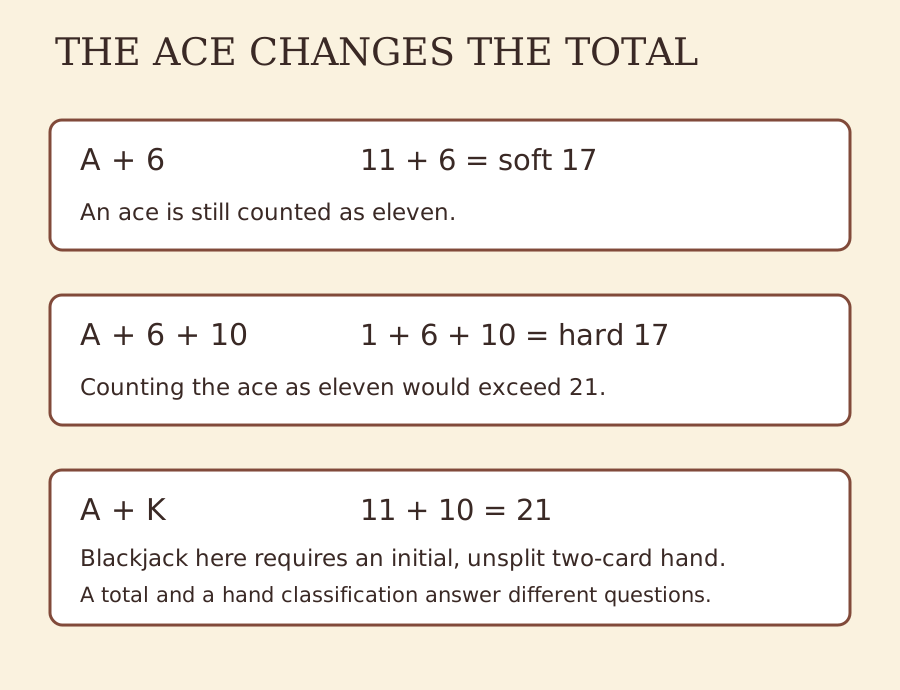
Online blackjack explained: hands, aces and the rules that change them
Work through soft and hard hands, two-card blackjack, payout wording and dealer rules without mistaking a familiar game name for a complete rule set.
Read Online blackjack explained: hands, aces and the rules that change them
Continue reading
Blackjack dealer rules for beginners: the rule, the hand, and what it costs
The dealer has no decisions: draw to 16, stand on 17, and the panel says what happens on soft 17. Each dealer rule line, what it costs in percentage points, and what that is on a £20 hand.
Read Blackjack dealer rules for beginners: the rule, the hand, and what it costsBlackjack surrender depends on when the dealer's blackjack is resolved
Read early, late and conditional surrender through a £20 settlement table. See why requesting surrender before the reveal need not guarantee half back.
Read Blackjack surrender depends on when the dealer's blackjack is resolvedRead the payout before the table name
A blackjack label alone does not tell you how a winning natural is paid.
Read Read the payout before the table nameRecord the rules you need to check
Read the payout before the table name
Soft seventeen is a rule question
Which blackjack table rules change the house edge, and by how much
Blackjack dealer rules for beginners: the rule, the hand, and what it costs
Blackjack surrender depends on when the dealer's blackjack is resolved
Online blackjack explained: hands, aces and the rules that change them