Rule variants
Which blackjack table rules change the house edge, and by how much
Every online blackjack table publishes its rules. Almost none publishes what those rules cost. This page puts a number beside each line of the rule sheet, shows where each number comes from, and gives you a list to read any table's panel against.
Where the numbers start: a baseline and a method
A house edge figure for blackjack is only meaningful against a stated rule set, because the rules are what the figure measures. This page uses the reference point published by Michael Shackleford's Wizard of Odds, whose rule-variations table is the standard citation for this arithmetic. Its baseline is stated on the page: "eight decks, dealer stands on soft 17, player may double on any first two cards, player can double after splitting, player may split to 4 hands." Every effect in the table below is a change relative to that baseline, for a player using basic strategy.
The same author's overview page gives a house edge for what it calls Atlantic City rules ("dealer stands on soft 17, split up to 4 hands, double after split, double any two cards") of 0.43%. That matches the baseline rule set, so 0.43% is the starting figure used throughout this page. It assumes a 3-to-2 blackjack payout, no surrender, no re-splitting of aces and a dealer who checks for blackjack before the player acts.
The method is arithmetic, not testing. Take 0.43%, add the cost of each unfavourable rule on the table, subtract the value of each favourable one. The result is an approximation because the effects interact slightly; the Wizard's own house edge calculator, which accepts the same inputs, gives the exact figure for any combination and is the tool to use if the third decimal place matters. Nothing on this page was played, and no operator's table was tested.
One term is worth fixing before the numbers. A "percentage point" here means a change to the return on each unit staked. A rule that costs 0.22 points turns a 0.43% edge into a 0.65% edge; on £100 of total stakes, that is an expected 65p rather than 43p retained by the house over the long run. The general concept of house edge and why it is an average rather than a session forecast is explained at length by Odds & Ends; this page applies it to one game.
Sources: Wizard of Odds: Blackjack rule variations; Wizard of Odds: Blackjack basics; Wizard of Odds: Blackjack house edge calculator.
The rule-variant table
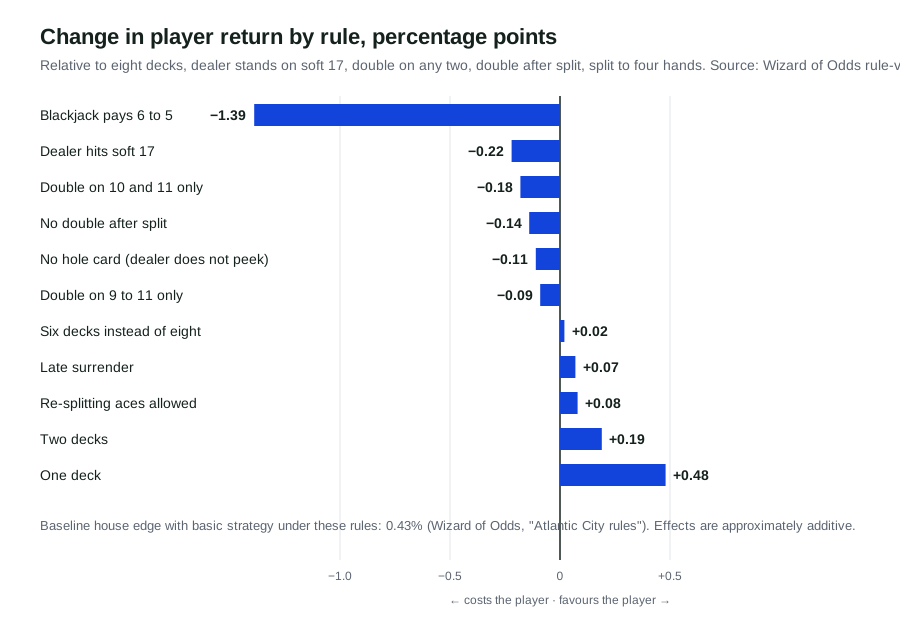
The table lists the rules an online panel most often varies, what the favourable and unfavourable versions look like on screen, and the effect of the unfavourable version on the player's return. Signs follow the player: a negative number is money the rule moves toward the house.
| Rule on the panel | Baseline version | Variant | Effect on player return | Source figure |
|---|---|---|---|---|
| Blackjack payout | Pays 3 to 2 | Pays 6 to 5 | −1.39 points | Wizard of Odds: "Blackjack pays 6-5: −1.39%" |
| Blackjack payout | Pays 3 to 2 | Pays 1 to 1 (even money) | −2.27 points | Wizard of Odds: "Blackjack pays 1 to 1: −2.27%" |
| Dealer's soft 17 | Dealer stands (S17) | Dealer hits (H17) | −0.22 points | Wizard of Odds: "Dealer hits on soft 17: −0.22%" |
| Hole card | Dealer takes a hole card and checks for blackjack | No hole card; dealer's second card dealt after players act (common on European-style tables) | −0.11 points | Wizard of Odds: "European no hole card: −0.11%" |
| Double after split | Allowed (DAS) | Not allowed | −0.14 points | Wizard of Odds: "Player may not double after splitting: −0.14%" |
| Doubling totals | Any first two cards | Only on 9, 10, 11 | −0.09 points | Wizard of Odds: "Player may double on 9-11 only: −0.09%" |
| Doubling totals | Any first two cards | Only on 10, 11 | −0.18 points | Wizard of Odds: "Player may double on 10,11 only: −0.18%" |
| Re-splitting aces | Not allowed | Allowed | +0.08 points | Wizard of Odds: "Player may resplit aces: +0.08%" |
| Surrender | None | Late surrender (after the dealer checks for blackjack) | About +0.07 points | Wizard of Odds: "Late surrender against ten: +0.07%"; "Late surrender against ace: +0.00%" |
| Surrender | None | Early surrender (before the dealer checks) | Up to +0.63 points | Wizard of Odds: "Early surrender against ace: +0.39%"; "Early surrender against ten: +0.24%" |
| Number of decks | Eight | Six | +0.02 points | Wizard of Odds: "Six decks: +0.02%" |
| Number of decks | Eight | Four | +0.06 points | Wizard of Odds: "Four decks: +0.06%" |
| Number of decks | Eight | Two | +0.19 points | Wizard of Odds: "Double deck: +0.19%" |
| Number of decks | Eight | One | +0.48 points | Wizard of Odds: "Single deck: +0.48%" |
Three worked sums show how to use it. A table with the baseline rules but no hole card, which describes many European-format online tables: 0.43 + 0.11 = a house edge of about 0.54%. A table where the dealer hits soft 17, blackjack pays 6 to 5 and doubling after a split is refused: 0.43 + 0.22 + 1.39 + 0.14 = about 2.18%. A six-deck table with a standing dealer, late surrender and re-splitting of aces: 0.43 − 0.02 − 0.07 − 0.08 = about 0.26%. The spread between the second and third tables is roughly eight to one, and every rule that produces it is printed on the panel.
Why 6 to 5 is the line that matters most
The payout on a natural blackjack is the single largest lever on the panel, and the reason is visible from first principles. The cost of a worse payout is the amount lost per blackjack multiplied by how often a paid blackjack occurs, so both halves can be checked.
Start with the frequency. In eight decks there are 416 cards, 32 of them aces and 128 of them ten-value cards. The chance that the first two cards are an ace and a ten in either order is 2 × (32 ÷ 416) × (128 ÷ 415), which is 0.04745, or about one hand in 21. A blackjack is only paid at the premium rate when the dealer does not also hold one; the chance the dealer has a blackjack given that the player already holds an ace and a ten is 2 × (31 ÷ 414) × (127 ÷ 413), about 0.0461. Multiplying through, a paid player blackjack occurs on about 4.53% of hands.
Now the amount. At 3 to 2, a £10 stake wins £15. At 6 to 5, it wins £12. The difference is £3 on a £10 stake, or 0.3 of the stake. Multiply 0.3 by 4.53% and the cost of the 6-to-5 rule comes out at about 1.36 percentage points. The Wizard of Odds table gives 1.39. The same working applied to a 2-to-1 payout gives 0.5 × 4.53% = 2.26 points in the player's favour, against the Wizard's 2.27, and applied to even money gives 2.26 points against, versus the published 2.27. The small gaps are the price of doing the sum on a napkin rather than with a full combinatorial analysis; the published figures, not this working, are what the table cites.
The scale is what matters. Every other row in the table is measured in hundredths of a point; this one is measured in whole points. A table advertising a single deck, which is worth 0.48 to the player, but paying 6 to 5, which costs 1.39, is a worse table than an eight-deck game paying 3 to 2. The Massachusetts Gaming Commission's published blackjack rules, which this site uses as a comparative reference because they are a regulator's own text, permit a licensee to pay "at odds of 3 to 2, or at odds of 6 to 5", and treat the two as alternatives within the same game. Our shorter note on reading the payout before the table name covers how the ratio appears on screen.
Sources: Wizard of Odds: Blackjack rule variations; Massachusetts Gaming Commission: Blackjack rules.
Dealer rules: soft 17 and the hole card
A soft 17 is an ace counted as eleven plus cards totalling six; ace-six is the plain case. The Massachusetts rules define a soft total as "the total point count of a hand containing an ace when the ace is counted as 11 in value", and give the dealer two permitted procedures in section 12(b): draw until reaching "a hard or soft total of 17, 18, 19, 20 or 21", which means standing on soft 17, or draw until reaching a hard 17 or better or "a soft total of 18, 19, 20 or 21", which means hitting soft 17. Online panels abbreviate these as S17 and H17.
Hitting soft 17 helps the dealer because a soft 17 cannot bust on the next card and usually improves. The Wizard's dealer-outcome tables for six decks show the effect directly: with a 6 showing, a standing dealer busts 42.28% of the time and a hitting dealer 43.93%, but the hitting dealer converts many of the soft 17s that would otherwise stand into 18s, 19s, 20s and 21s. The net cost to the player is 0.22 points. Our earlier note, soft seventeen is a rule question, explains why the phrase "dealer stands on 17" is incomplete until the panel says which 17.
The hole card is the other dealer rule. On a table where the dealer takes a second card face down and checks it for blackjack before anyone acts, a player who doubles or splits against a dealer ace or ten loses only the original stake if the dealer turns out to have a natural. On a no-hole-card table the dealer's second card comes after the players have finished, so a player who has doubled to £20 against a dealer ten can lose all £20 to a dealer blackjack. The Wizard's table separates the two parts of the cost, 0.08 from doubling and 0.03 from splitting, for 0.11 in total, and notes that some no-hole-card tables refund the extra stake, in which case the cost disappears. That refund rule, where it exists, is a line on the panel and should be read.
Sources: Massachusetts Gaming Commission: Blackjack rules; Wizard of Odds: Dealer probabilities, no-hole-card rules; Wizard of Odds: Blackjack rule variations.
Player options: doubling, splitting and surrender
Doubling is worth the most of the player's options, which is why restricting it costs the most. A player who may never double gives up 1.48 points; one restricted to doubling on 9, 10 or 11 gives up 0.09, and one restricted to 10 or 11 gives up 0.18. The difference between those two restrictions is the soft doubles (ace-two through ace-seven against a weak dealer card) and the hard 9 against a 3 to 6, all of which basic strategy calls for on an unrestricted table.
Double after split is a narrower right: after splitting, say, a pair of eights, each new hand may be doubled if a good card arrives. Removing it costs 0.14 points. Re-splitting aces is narrower still. Most tables deal one card to each split ace and stop, as the Massachusetts rules put it in section 11(c)(2): "A player splitting aces shall only have one card dealt to each ace and may not elect to receive additional cards." A table that allows a further split when another ace lands is worth 0.08 points to the player.
Surrender lets a player give up the hand and keep half the stake. Late surrender, offered only after the dealer has checked for blackjack, is worth about 0.07 points, almost all of it against a dealer ten; the Wizard's table shows the value against an ace as 0.00 at the baseline rules. Early surrender, offered before the dealer checks, is worth far more, 0.39 against an ace and 0.24 against a ten, because it lets the player escape a dealer blackjack. Early surrender is rare; where a panel says only "surrender", it almost always means late, and the panel should be read for the exact timing.
Sources: Wizard of Odds: Blackjack rule variations; Massachusetts Gaming Commission: Blackjack rules.
Deck count is real but small
Fewer decks favour the player for two reasons that the 6-to-5 arithmetic already hinted at. Blackjacks are slightly more frequent with fewer decks, because drawing an ace removes a larger share of the remaining aces and a ten is then relatively more likely; and doubling on 10 or 11 works slightly better, because the small cards already in the player's hand are a larger share of what has been removed. The published effects are +0.02 for six decks, +0.06 for four, +0.19 for two and +0.48 for one, all against eight.
Two things follow. First, the step that online panels most often offer, eight decks to six, is worth two hundredths of a point, which is smaller than every other row in the table. Second, a single-deck label is only worth its 0.48 if the other rules are held constant, and single-deck tables are the ones most often paired with a 6-to-5 payout. The Massachusetts rules set a minimum of one deck for the base game but require more for certain side wagers; an online panel that states the deck count should also state whether the shoe is dealt to a cut card or reshuffled every hand, since the Wizard's calculator reports different figures for the two.
Sources: Wizard of Odds: Blackjack rule variations; Wizard of Odds: Blackjack house edge calculator; Massachusetts Gaming Commission: Blackjack rules.
Hard 14, 15 and 16: why the dealer's card decides
The most-asked question about blackjack play has a rule-shaped answer: whether to hit a hard 14, 15 or 16 depends on the dealer's up-card, and the reason is the dealer's own bust rate. The figures below are from the Wizard's six-deck, dealer-stands-on-soft-17 table, calculated before the dealer checks for blackjack, so the ace and ten rows include the dealer's chance of a natural.
| Dealer shows | 2 | 3 | 4 | 5 | 6 | 7 | 8 | 9 | 10 | Ace |
|---|---|---|---|---|---|---|---|---|---|---|
| Dealer busts | 35.4% | 37.4% | 39.6% | 41.8% | 42.3% | 26.2% | 24.4% | 22.9% | 21.2% | 11.5% |
| Dealer blackjack | 0 | 0 | 0 | 0 | 0 | 0 | 0 | 0 | 7.7% | 30.9% |
| Basic strategy with hard 13 to 16 | Stand | Stand | Stand | Stand | Stand | Hit | Hit | Hit | Hit | Hit |
A hard 14, 15 or 16 is a hand that loses if it stands and the dealer makes any total, and busts if it hits and draws anything above a seven, six or five respectively. Against a 2 to 6, the dealer busts between 35% and 42% of the time, so standing and letting the dealer take that risk is the better of two poor choices. Against a 7 or higher, the dealer busts about a quarter of the time or less and will usually finish on 17 or better, so a standing 14, 15 or 16 loses most of the time and hitting, despite its own bust risk, loses less often.
The Wizard's four-to-eight-deck basic strategy chart, which assumes the dealer stands on soft 17 and surrender is allowed, encodes exactly this: hard 13 to 16 stands against a 2 through 6 and hits against a 7 through ace, with a hard 12 hitting against a 2 and 3 as well because a 12 cannot bust on a single ten. Where late surrender is on the panel, the same chart says surrender a hard 16 against a 9, 10 or ace and a hard 15 against a 10, since half the stake back beats the expected loss from either hitting or standing.
This is a total-dependent chart, meaning the advice depends on the total and the dealer's card, not on which cards make the total. A composition-dependent strategy adjusts a few borderline plays, such as some 16s made of three or more cards, and the Wizard's calculator reports the gain from it separately; for reading a rule panel, the total-dependent chart is enough. The chart also changes slightly when the dealer hits soft 17, which is another reason the panel comes before the chart.
Sources: Wizard of Odds: Dealer probabilities, no-hole-card rules; Wizard of Odds: 4-deck to 8-deck basic strategy; Wizard of Odds: Blackjack house edge calculator.
A checklist for any online rule panel
British-licensed remote operators are required to publish game rules. The Gambling Commission's Remote gambling and software technical standards say, at RTS requirement 3A, that "An explanation of the applicable rules must be easily available to the customer before they commit to gamble", and at 3C that information enabling "an informed decision about his or her chances of winning", including "house edge (or margin)", "return to player (RTP) percentage" and "probability (likelihood) of winning events occurring", must be easily accessible before wagering. The rules panel, help page or information icon on an online blackjack table is where that obligation is discharged.
The standard does not say that the panel must list rule costs, and none of the panels this site has read do. The checklist below is the list of lines to find, in the order of their weight in the table above, with the question to answer for each.
- Blackjack payout. Find the ratio, not the word. "Blackjack pays 3:2" is the baseline; "6:5", "6 to 5" or "1.2 to 1" costs 1.39 points; "even money" costs 2.27. If the panel gives only an RTP percentage, work back: an RTP below about 98.5% on an otherwise ordinary table is a signal to look for the payout line.
- Dealer's soft 17. Find "stands on soft 17", "S17", "hits soft 17" or "H17". "Dealer stands on 17" without the word soft is incomplete; the Massachusetts wording shows both procedures are legitimate, so the panel must say which.
- Hole card. Find whether the dealer draws a second card before or after the players act, and, if after, whether a doubled or split stake is returned when the dealer makes blackjack. No hole card without a refund costs 0.11.
- Doubling. Find the permitted totals: any two cards, 9 to 11, or 10 and 11. Then find whether doubling after a split is allowed.
- Splitting. Find how many times a hand may be split, whether aces may be re-split, and whether split aces receive one card only.
- Surrender. Find whether it exists and whether it is offered before or after the dealer checks for blackjack.
- Decks and shuffle. Find the deck count and whether the shoe is dealt to a cut card or reshuffled every round. Weigh this line last; eight to six is worth 0.02.
- Side bets. Treat each as a separate game with its own return. A side bet's house edge does not change the main hand's, and the Wizard's rule-variations figures do not cover them.
- Version and date. Record the game title, provider and the date you read the panel. A rule set can change between versions of the same title.
Sum the lines you found using the table in part 2, starting from 0.43. If the result differs materially from the RTP the panel states, the most likely explanation is a line you have not found; the second most likely is a rule this page does not cost, such as a bonus payout for certain hands or a limit on the number of cards a hand may draw. Leave the difference recorded as unresolved rather than assumed.
Sources: Gambling Commission: RTS 3, rules, game descriptions and the likelihood of winning; Massachusetts Gaming Commission: Blackjack rules.
What these figures do not say
Every figure on this page is a long-run average for a player using basic strategy. A 0.43% house edge does not mean a £10 hand loses about 4p; it means that across a very large number of hands the total staked and the total returned differ by about that proportion. Individual sessions are dominated by variance, and a run of hands is not evidence for or against any of the numbers here. A player who departs from basic strategy faces a larger edge than the rule set implies; the Wizard's overview estimates that even his deliberately simplified 21-rule strategy gives up a further 0.14 points against liberal rules.
The figures also do not establish anything about a named operator. The Massachusetts document is a US regulator's rule text used here because it is public and precise, not because it governs any British table; the Gambling Commission's RTS sets what must be displayed, not which rules a table may use. Where a live-dealer table adds a decision timer, a disconnection policy or a round record, those are streaming matters and Live Table Notes covers them; they do not alter the arithmetic above. And the general how-to-play material, soft and hard hands, what counts as a natural and how a payout is settled, lives in this site's guide to online blackjack hands and the rules that change them. This page assumes that vocabulary and costs the rules instead.
Finally, "blackjack" on a UK search result can mean a seven-card family card game that has nothing to do with the casino table. Nothing here applies to it.
Sources: Wizard of Odds: Blackjack basics; Gambling Commission: RTS 3.
Rule references
- Blackjack rule variations, Wizard of Odds, retrieved 18 September 2026.
- 4-deck to 8-deck blackjack basic strategy, Wizard of Odds, retrieved 18 September 2026.
- Blackjack appendix 2B: dealer probabilities under no-hole-card rules, Wizard of Odds, retrieved 18 September 2026.
- Blackjack basics and house edge, Wizard of Odds, retrieved 18 September 2026.
- Blackjack house edge calculator, Wizard of Odds, retrieved 18 September 2026.
- RTS 3: Rules, game descriptions and the likelihood of winning, Gambling Commission, retrieved 18 September 2026.
- Blackjack rules (9 April 2026), Massachusetts Gaming Commission, retrieved 18 September 2026.