Core guide
Online blackjack explained: hands, aces and the rules that change them
Work through soft and hard hands, two-card blackjack, payout wording and dealer rules without mistaking a familiar game name for a complete rule set.
Read the hand before reading a strategy label
Blackjack explanations often begin with an instruction about what to do next. A more reliable starting point is to understand the hand and the rules under which it is being described. A total, a soft or hard classification, a natural blackjack and a permitted action are different pieces of information. Confusing them can make an otherwise correct sentence misleading.
This guide is an educational reading aid for online blackjack information. It does not supply live playing decisions or claim to have tested a casino. The card examples and interactive worksheet are original illustrations. They can be examined without a gambling account, deposit or actual game.
We use a published regulator’s blackjack rules as a clearly identified comparative reference. The Massachusetts document is not a statement of UK law or a promise that every online variant uses the same conditions. Its value is that definitions, dealer alternatives and payout wording can be inspected together. When considering a named online game, its own rules still determine which description applies.
Record the exact title and any version or variant label before comparing explanations. “Blackjack” on its own is too broad to settle every question about hands, dealing, payouts and optional features. A shared card illustration does not make two different rule panels interchangeable.
The ace is flexible; the total still has a precise meaning
In the model used here, number cards carry their face value, picture cards count ten, and an ace counts eleven unless that would take the hand above 21, in which case it counts one. A hand is soft when an ace still counts eleven. It is hard when none does.
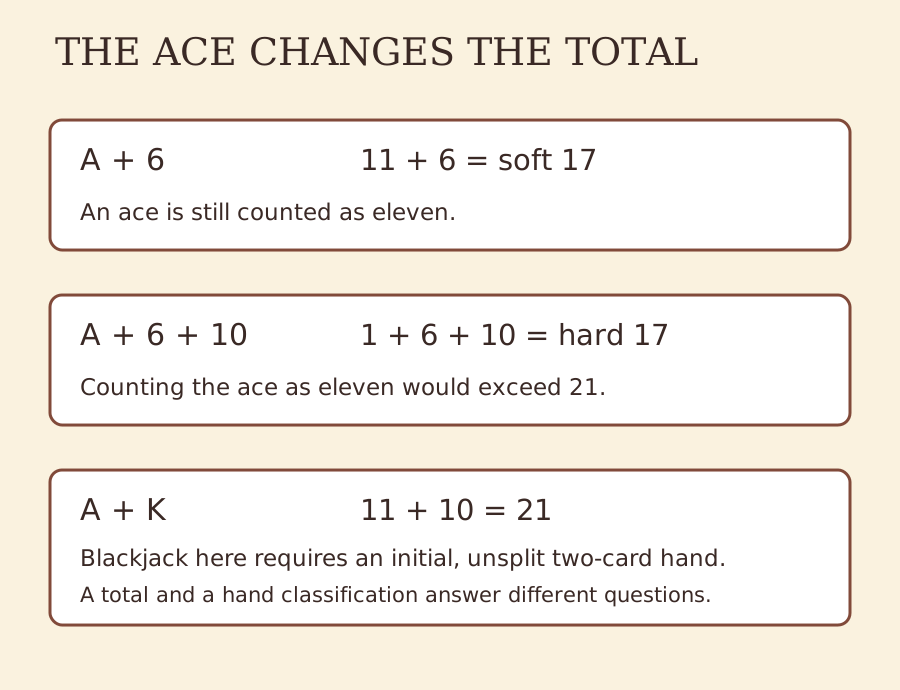
Start with ace and six. Eleven plus six is 17, so this is soft 17. Add a ten-value card. Keeping the ace at eleven would produce 27; counting it as one produces 17. The result is hard 17. The same printed ace remains present, but its value in the total has changed. Calling every hand containing an ace soft would therefore be wrong.
Now compare two aces and a five. Counting both aces as eleven gives 27. Reducing one ace to one gives 17, with the other ace still worth eleven: soft 17. Add a ten-value card to that example and the second ace must also become one, leaving 17 with no ace counted eleven. This is hard 17.
The worksheet works through two or three selected cards and displays the resulting label. It is a classifier, not a strategy engine. It does not consider a dealer’s upcard, deck composition, financial exposure or a recommended action. Those missing inputs should not be imagined from the simplicity of its answer.
As a counterexample, ten, eight and five total 23. There is no ace available to reduce, so this is a bust in the stated model. The worksheet keeps that result separate from a hard hand at or below 21.
Why 21 is not always blackjack
An initial ace and king make 21 in two cards. Under the reference definition, that is blackjack when the hand was not formed after splitting. A seven, four and queen also total 21, but they do not meet that definition. The sum is the same; the hand category is different.
Context supplies another difference. An ace plus a ten-value card after splitting may still total 21 while failing the initial-unsplit condition. A screenshot of two cards without the round context may therefore be insufficient to classify the hand. The worksheet includes a context control for exactly this reason rather than assuming that every two-card display is an initial deal.
Consider how to describe an example accurately. “The cards total 21” is a claim about arithmetic. “This is a natural blackjack” adds a claim about the number of cards and how the hand arose. “This receives the blackjack payout” adds a further claim about the applicable settlement rules and the opposing hand. Each additional statement needs its own condition.
This matters when reviewing game help pages. A rules panel should make the category understandable, but an abbreviated animation might show only a total. Do not treat the animation as a replacement for the definition. If a variant uses a different label or exception, record that difference explicitly instead of silently importing the model used in this guide.
An offline card selector that calculates the total and distinguishes soft, hard, bust and initial unsplit blackjack.
Separate the card result from the amount returned
Payout language answers a different question from hand classification. In a hypothetical example with a £10 stake and a 3-to-2 profit payout, the profit is £15. If the original stake is returned as well, the total returned is £25. With a 6-to-5 profit payout on that same stake, the corresponding figures are £12 profit and £22 total returned.
Those two calculations differ by £3 on the specified winning event. They do not calculate the overall house edge of a complete blackjack game. That would require the rest of the rules and an appropriate model of decisions and outcomes. A single payout comparison must not be presented as a full game analysis.
Our focused blackjack payout explanation expands the distinction between profit and the returned stake. Use it when a caption simply says “pays” without making the convention clear. In a document review, retain the exact ratio and identify what event it applies to before turning it into money.
Settlement also depends on the opposing hand and the applicable rules. A total of 21 is not enough information to infer an account credit. For a disputed historical result, the round reference and the rules relevant to that round would be needed. This guide’s arithmetic examples do not establish what happened in any actual account.
The UK remote standards address rules and payout information. That provides a reason to look for the specific explanation, not a licence to reconstruct missing terms from a competitor’s page.
Sources: UK Gambling Commission: RTS 3 — Rules and game information.
Soft 17 is a dealer-rule question
The phrase “soft 17” names a type of hand. It does not, by itself, tell you whether the dealer draws another card. The comparative rules document contains alternative dealer procedures: one stops on soft 17, while another continues until at least soft 18 or an applicable hard stopping total. A named game must specify its own procedure.
Return to ace and six. The arithmetic remains soft 17 under either procedure. What changes is the rule applied to that total. An explanation that alters the value of the ace to justify a dealer action has confused the hand with the procedure.
Our note on the soft-seventeen rule isolates this issue. For a wider online-game comparison, record it beside the blackjack payout and the conditions on additional actions. Do not assume that one favourable-looking line identifies every other setting on the table.
A practical comparison can use two written records. Record A states its payout and soft-17 procedure; record B states its own. If B omits the latter, mark it unresolved. Filling the gap by copying A would create a false match. Likewise, do not assume an online interface’s colour or layout identifies a rule variant.
Other conditions may concern splitting, doubling or the timing of checks for dealer blackjack. This guide does not supply an exhaustive strategy for those combinations. Its purpose is to make clear which question remains unanswered when a generic chart or brief game description omits the actual rule set.
Use demonstrations to learn the labels, not infer results
An online demonstration can help a reader locate a rules control or see how a hand total is labelled. It cannot establish the likelihood of every result from a short sequence of hands. A promotional clip is even narrower evidence because it may show selected or accelerated events rather than an ordinary sequence.
The UK standard for corresponding play-for-free games addresses their relationship with the real-money version and distinguishes promotional demonstrations that need clear labelling. It does not turn a handful of observed demo hands into proof of fairness or a forecast of future returns.
For a useful document record, keep the demonstration type, game identity and source date together. State whether the evidence is a rules page, a provider explanation, a promotional video or an observed public interface. Do not invent a first-hand playing experience to make a review sound more complete.
The original diagram and worksheet on this page are expressly teaching materials. They use selected cards, contain no random dealing and do not reproduce a casino interface. Their outputs can answer what a model hand is called; they cannot answer whether an operator paid correctly, whether a strategy is profitable or what the next card will be.
Once the hand, context and rule are separate, online blackjack information becomes easier to read. The aim is a precise explanation that another reader can check, including a clear unresolved result wherever the actual game’s information is missing.
Sources: UK Gambling Commission: RTS 6 — Play-for-free games.
Questions answered
Can a hard blackjack hand contain an ace?
Yes. In this model a hand is hard when no ace is counted as eleven. Ace, six and ten total hard 17 because the ace must count one.
Is an ace and a ten after splitting blackjack?
Under the stated reference definition it totals 21 but does not qualify as initial unsplit two-card blackjack. Check the exact game’s own definition and settlement rules.
Does the hand reader tell me when to hit or stand?
No. It classifies selected cards and contains no playing recommendations, dealer-upcard analysis or live game connection.